
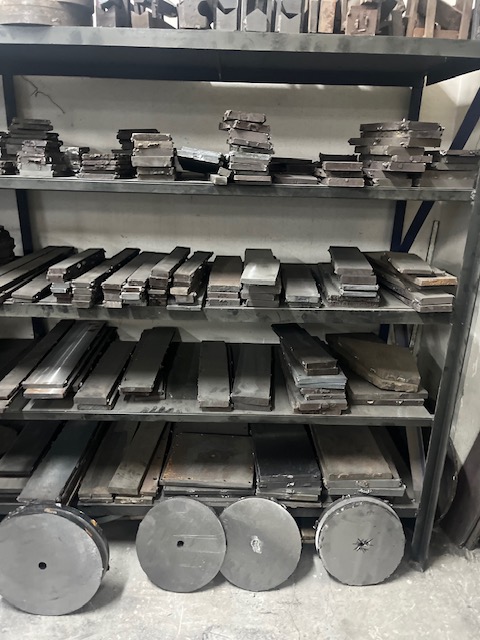
What determines the material choice?
Wear resistance, toughness and corrosion resistance must be balanced for the application. Cutting material, thickness, fillers, possible foreign objects, temperature and cleaning conditions all matter. Higher hardness alone does not guarantee a longer tool life. The cutting geometry, support and condition of the machine also influence the result.
Material groups and individual grades
The following grades are examples used in industrial cutting-tool applications. A material number identifies a grade, not a finished-tool specification. Delivery condition, heat treatment, working hardness and surface finish must be agreed separately.
Carbon strip steel C100S / 1.1274
C100S is a high-carbon strip steel used for thin industrial blades and round blades, depending on the design. Its designation was formerly Ck101. It can provide a keen cutting edge after suitable hardening and grinding. It is not stainless; moisture and the required protection must be considered.
Cold-work steels 1.2510 and 1.2842
These are different grades: 1.2510 is 100MnCrW4, while 1.2842 is 90MnCrV8. Both are used for cutting and punching tools where the design and loading are suitable. They are not interchangeable solely because their application ranges overlap. The exact grade and required heat treatment belong in the specification.
Wear-resistant cold-work steels 1.2379 and 1.2436
1.2379 is a high-alloy chromium cold-work steel used for knives and punching tools. Despite its chromium content, it must not be treated as stainless. 1.2436 is another high-carbide cold-work steel for wear-intensive cutting applications. Carbide distribution, toughness requirements and the risk of edge chipping must be considered alongside wear resistance.
High-speed steel 1.3343 / HSS
1.3343, also designated HS6-5-2C, combines wear resistance with hot-hardness properties. It is used for cutting tools and, where appropriate, industrial and circular knives. Whether these properties are needed depends on the actual process; HSS is not automatically the most economical choice for every knife.
Martensitic stainless steels 1.4034 and 1.4112
1.4034 (X46Cr13) and 1.4112 (X90CrMoV18) can combine hardenability with corrosion resistance. These properties depend on heat treatment, surface condition and the environment. Food-contact requirements, cleaning chemicals, salts and temperature must be specified for the actual tool. A material number alone is not a blanket food-contact approval.
Cemented carbide
Cemented carbide is a composite, typically containing tungsten carbide as the hard phase and a metallic binder such as cobalt. Grade and grain size affect wear resistance and toughness. Solid carbide and carbide-tipped knives are different constructions. For abrasive materials, the potential wear benefit must be assessed against impact loading, foreign objects and the risk of chipping.
Heat treatment and cutting-edge geometry
For steels, the final working condition is established by the appropriate heat treatment and finishing process. Target hardness must suit the grade, cross-section and application; hardness values are not supplied here as universal limits. Cutting angle, edge support and surface finish also need to be specified. Requirements for grinding or electrical-discharge machining depend on the material and tool geometry.
Materials at a glance
A starting point for your enquiry, not a universal ranking. The appropriate material and finished-tool condition are agreed for the application.
On smaller screens, scroll the table sideways.
| Material | Characteristics | Typical applications | Selection considerations |
|---|---|---|---|
| C100S1.1274 | High-carbon strip steel; not stainless. | Thin industrial blades, round blades and flexible cutting elements, subject to design. | Specify delivery condition, hardness, thickness and protection against corrosion. |
| 1.2510100MnCrW4 | Cold-work steel for a balanced cutting-tool specification. | Shear knives, punching knives and special cutting tools. | A different grade from 1.2842; confirm the exact material. |
| 1.284290MnCrV8 | Cold-work steel with an overlapping application range. | Punching and cutting tools, depending on geometry and loading. | Do not substitute for 1.2510 without technical agreement. |
| 1.2379X153CrMoV12 | High wear resistance; not stainless. | Machine knives, circular knives and punching tools. | Consider toughness and corrosion protection, not only hardness. |
| 1.2436X210CrW12 | High-carbide, wear-resistant cold-work steel. | Knives for wear-intensive cutting processes. | Review impact loading and the risk of edge chipping. |
| 1.3343HS6-5-2C | High-speed steel with wear resistance and hot hardness. | Industrial knives, circular knives and other cutting tools. | Match the benefits to process temperature, load and geometry. |
| 1.4034X46Cr13 | Hardenable martensitic stainless steel. | Cutting tools where corrosion resistance is required. | Assess environment, cleaning, heat treatment and surface condition. |
| 1.4112X90CrMoV18 | Martensitic stainless steel for wear-resistant cutting edges. | Circular and industrial knives, subject to the application. | Food-contact and chemical-resistance requirements need a specific review. |
| Cemented carbide | High wear resistance; properties depend on the grade. | Solid-carbide or carbide-tipped knives for abrasive materials. | Consider carbide grade, edge geometry, impact and foreign objects. |
Your material requirements
Please provide a drawing, quantity and the material to be cut. Add any prescribed tool grade, target hardness, thickness, process temperature and cleaning conditions. If an existing knife wears prematurely or chips, photographs and a description of the failure help with the review.
Discuss your material requirements